
We study community ecology in wild and managed ecosystems
1. Can we support pollinators AND maintain high quality fruit production?
Effective crop pollination services arise from the interactions between flower-visitors and plants, resulting in increased yields and/or higher quality produce. The strength of this relationship to yield depends on how much the crop plant benefits from pollination (i.e. pollinator dependency) and the efficiency of a given insect when visiting the crop flower (i.e. crop pollinator efficiency). Many studies report positive benefits to flower-visitor abundances when providing additional non-crop flowers, however, the addition of non-crop floral resources per se, does not necessarily guarantee yields as pollinators do not visit all flowers available and differences in foraging behaviour can result in some flowers, native or introduced, being used in preference to others. Understanding the mechanisms underlying crop pollination and pollinator health in unison benefits both industry and conservation. This work is funded by an Australian Research Council Future Fellowship grant FT210100851.
2. Pollinator Identity and Ecology
Pollinator communities include native and introduced bees, flies, beetles, moths, butterflies, and birds, as well as other taxa. These taxa provide pollination services for up to 87.5% of all flowering plants and 75% of the leading global food crops. We are interested in finding out which pollinators visit which crops and how effective they are in a range of food crops. These projects were funded by the Australian Government Department of Agriculture and Water resources, Horticulture Innovation Australia and AgriFutures as part of the Rural R&D for Profit Programme. Earlier work was funded by the Ian Potter Foundation.
3. Pollination in Protected Cropping Systems
Protective covers (i.e. glasshouses, netting enclosures and polytunnels) are increasingly being used in crop production to enhance crop quality, yield and production efficiency. However, the majority of protected crops require insect pollinators to achieve optimal pollination and there remains little consensus about how best to manage pollinators and crop pollination in these environments. This project aims to better understand pollinator behaviour and health in protected cropping systems. This project is being delivered by Hort Innovation – with support from the Australian Government Department of Agriculture and Water Resources as part of its Rural R&D for Profit program – and other partners including the University of New England.
4. The Mechanisms Underlying Crop Pollinator Effectiveness
Maximally effective pollination results from a complex assortment of factors that influence the pollination process before and after pollen deposition. The effectiveness of individual pollinators is determined by the combined outcomes of the amount, quality and timing of the pollen transferred which is strongly related to pollinator foraging behaviour, morphology and density. Variation in the identity and spatial and temporal structuring of plant and pollinator communities further affect effective pollination, impacting pollen availability and post-pollination factors, such as pollen-pistil and/or pollen-pollen interactions on the stigma. Pollination failure can thus result from problems at any or all of these stages of pollen transfer. This project was funded by the Australian Research Council via a Discovery Early Career Researcher Award (DECRA) awarded to Romina Rader (DE170101349).
Our lab is based at the University of New England, Armidale NSW Australia.
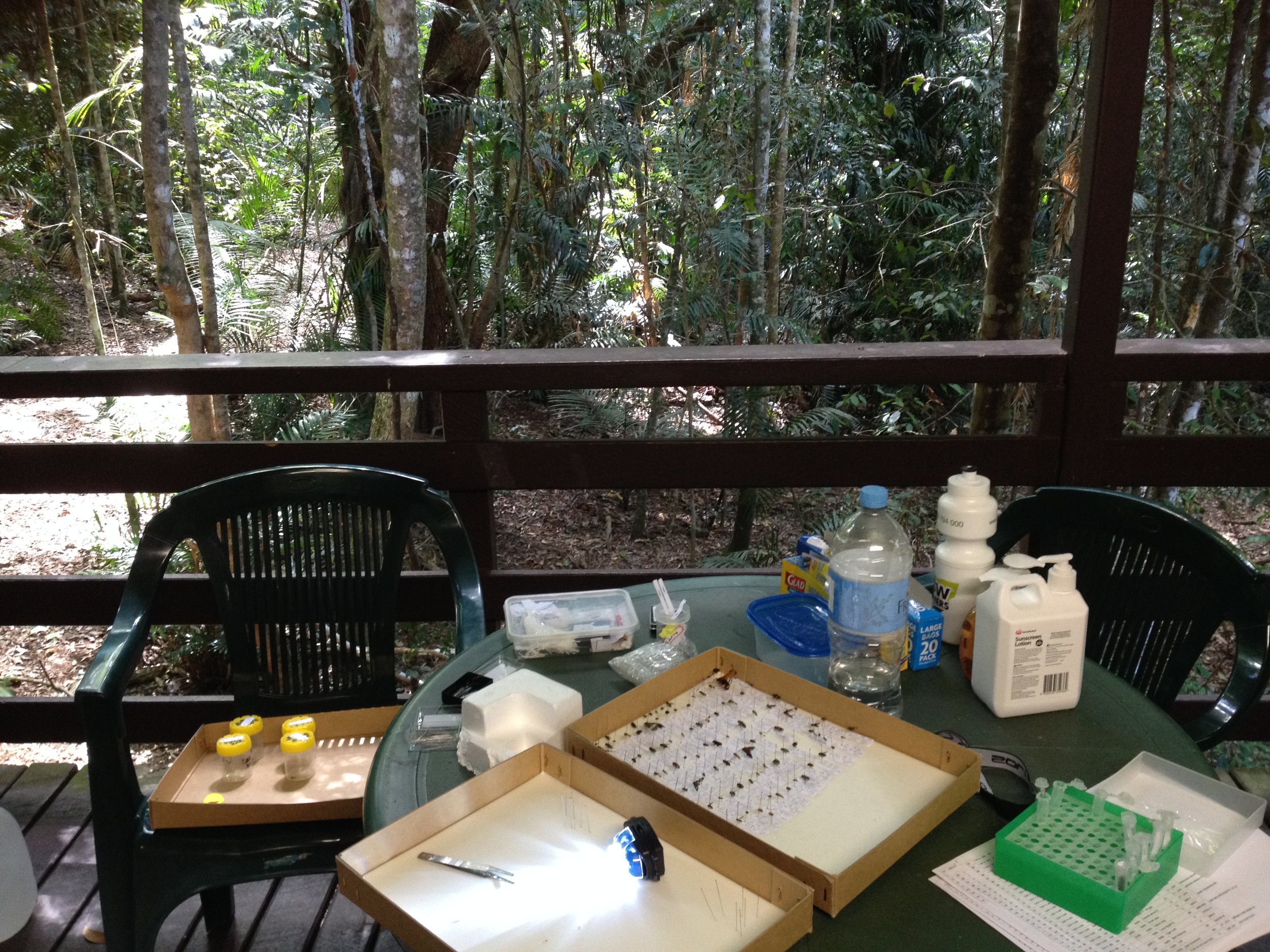
Pinning insects is all in a day's work

Sampling insect pollinators in mango orchards
